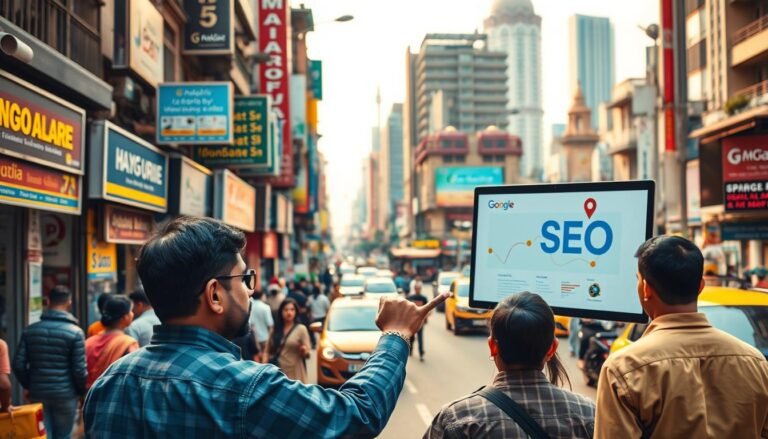
How Bangalore’s Tech Culture Influences Digital Marketing Trends
What if the way engineers solve problems in a city changes how brands talk to people online?
I study how local maker mindset and dense startup energy push rapid trials in AI adoption, voice search, hyper-local SEO, and short-form video. I watch how those moves reshape the digital landscape and business outcomes like reach, engagement, and revenue.
My focus is practical. I map audience behaviors—multilingual voice queries, reel-heavy consumption, and micro-influencer trust—into clear playbooks for brand growth. I track data signals, from zero-click search to predictive spend cycles, and tie each insight to measurable KPIs.
In this piece I share tactics I use now, not hype. You’ll get a playbook that scales from experiment to measurable lift, with examples tuned to local users and urban buyers.

Why Bangalore’s tech-first mindset is reshaping the digital landscape right now
An engineering-first city compresses experimentation cycles, and that speed shows up in how brands reach local audiences.
I see AI and automation move from lab proofs to daily tools. Predictive targeting and ChatGPT-style support are now mainstream for businesses here. That changes how I plan marketing strategy and allocate budgets.
Voice search in Kannada, Hinglish, and English is rising. “Near me” intent and complete Google My Business listings drive more footfall. Short-form video holds attention for three times longer, so I build video suited to commute-length viewing.

- I prioritize high-intent search, answer-first pages, and voice-friendly FAQs to capture intent.
- I use analytics to spot creative wear-out and reallocate spend to formats that sustain engagement.
- I operationalize data—GMB coverage, first-party signals under DPDP, and search forecasting—to lock visibility gains.
Working with a local partner who understands startup launches and enterprise pilots helps me avoid one-size-fits-all playbooks. That blend of rapid testing and measured analytics gives brands a practical edge right now.
Bangalore tech culture digital marketing trends
I see three distinct players shaping how I plan marketing in this market: startups, enterprises, and D2C brands. Each group runs different experiments and asks different KPIs. I map those differences into where I spend time and budget.
Startups favor AI-driven test-and-learn sprints. Enterprises focus on scaling automation across channels. D2C teams lean on creator-led work and fast video playbooks.
I also track present-day factors that change creative and search priorities. Multilingual users often switch between English, Hinglish, and Kannada, so I localize copy without losing clarity. Voice and “near me” queries push concise, answer-first pages.

- I prioritize formats by audience habits: short-form video, AR demos, and featured-snippet wins.
- I use micro-influencers to explain products quickly and build trust.
- I validate fit with small neighborhood tests, then scale budgets on clear insights.
These patterns tell me where to invest in search versus social, when to activate creators, and how to sequence content production for measurable lifts in brand reach and conversion.
AI and ML: Personalization, automation, and creative acceleration
I use AI to match the right content to the right user at the right minute, not just the right month. This shift moves personalization from a checkbox into day-to-day campaign work.
Predictive targeting and multilingual copy are now routine. I deploy Kannada and Hinglish prompts for short copy and use automated bidding to optimize spend for IT professional windows.
- I sequence offers and timing with predictive models to lift engagement and conversions for each cohort.
- My AI-readiness audit checks identity resolution, consent capture, event tracking, and data cleanliness to avoid blind spots.
- I pair automated bidding, dynamic creatives, and multilingual copy generation tools to speed output without losing brand voice.
| Capability | What I check | Present-day impact |
|---|---|---|
| Predictive sequencing | Cohort signals, timing windows | Higher conversion lift and repeat visits |
| CRM & ad stack audit | Identity, consent, event hygiene | Fewer automation errors, better personalization |
| Creative acceleration | Multilingual models, editorial guardrails | Faster production with on-brand copy |
I measure lift with holdouts, geo-splits, and incrementality tests. That proves value beyond vanity metrics and keeps customer trust intact.
Voice search and smart assistants in a multilingual city
Voice assistants are quietly rewriting how people ask for local information on phones and speakers. Usage is rising on Google Assistant and Alexa, and many users switch between English, Hinglish, and Kannada when they speak.
Optimizing for conversational queries in English, Hinglish, and Kannada
I extract conversational intents from real queries and map them to long-tail keywords that match how people speak. I write short, answer-first lines that assistants can read aloud, then add deeper content for readers and SEO.
Schema, long-tail phrasing, and “near me” intent
My schema approach uses FAQ, LocalBusiness, and Product markup to increase the chance of being chosen for spoken answers. I optimize GMB categories, Q&A, and posts so neighborhood qualifiers like “near Koramangala” are visible to assistants and customers on the move.
- I test utterance variations in English, Hinglish, and Kannada to boost recognition and match rates.
- I measure impact with assistant referrals, call clicks, and direction requests as voice-specific KPIs aligned to my marketing goals.
- I keep vertical playbooks—restaurants, co-working, healthcare—so brands can capture nearby discovery quickly.
These steps balance seo fundamentals with real-world optimization for users and support broader digital marketing objectives.
Hyper-local SEO and neighborhood-specific discoverability
Small, street-level signals often decide whether a nearby customer finds your shop or keeps scrolling. I apply focused local tactics so search and on-map visibility convert to real-world visits.
GMB accuracy, geo-tagged posts, and ward-level keywords
I keep Google My Business profiles complete and precise. Accurate categories, service areas, hours, and multilingual descriptions lift local results and trust.
I map ward-level keywords into business titles and product pages. This helps rank for neighborhood queries and match intent from nearby customers.
I schedule geo-tagged posts tied to local events and commute times to boost engagement and recency signals.
Local backlinks: startup directories, city influencers, and media
I build authority with relevant local directories and contextual mentions from neighborhood blogs and city media. These links help my pages outrank broader market pages.
- I partner with local creators and sector directories for contextual backlinks that drive clicks.
- I pitch short stories to local outlets to get citations that signal relevance for nearby searches.
What I measure: footfall proxies, calls, and direction requests
My KPIs tie search to offline activity. I track direction taps, call clicks, map views, and store visits where possible.
| Signal | Proxy | Action |
|---|---|---|
| Listing accuracy | Map views | Update GMB, categories, hours |
| Geo-posts | Engagement | Timed posts for events and commute |
| Local backlinks | Referral traffic | Directory outreach and influencer collabs |
I also optimize product and service pages with neighborhood modifiers and inventory cues. For multi-location businesses I use centralized governance and location-level calendars to scale this strategy while keeping local relevance tight.
Short-form video content: What works for Bangalore audiences
I plan video content around short attention windows and clear hooks. Data shows users spend more time on Reels and YouTube than reading long pages. Fifteen to twenty-two second clips fit commute pockets and lift completion rates.
Commute-time optimization: 15-22 second clips
- Hard hook in seconds 1–3 to stop the scroll.
- Format: problem, quick aha, clear CTA—keeps completion and engagement high.
- Silent autoplay ready with captions for noisy rides.
Behind-the-scenes and authentic storytelling
I use BTS from offices, hack nights, and maker labs because viewers prefer realism to glossy ads. These moments build trust fast and perform well for local audience segments.
Creative sequencing, testing, and tools
I test voiceover versus text-led edits and match edits to search spikes like product launches or events. My campaigns blend organic challenges, paid boosts, and creator stitches to compound reach.
I rely on simple tools and quick versioning workflows to localize by neighborhood and language without causing creative fatigue.
Micro-influencers and the rise of authentic, local voices
I rely on niche creators to translate product features into everyday value for nearby buyers. Over 80% of marketers say influencer work drives strong ROI, and I see that with local explainers and food explorers. They make complex ideas simple and build quick trust.
I shortlist creators who speak Bangalorean English and who have subject authority—cloud, dev tools, fintech, or healthtech. That match helps the brand reach the right customer without heavy education.
Contracting and content guardrails
I keep disclosures clear and require simple facts checks. Contracts include posting windows, mandatory disclosures, and brand-safety clauses. This protects reputation while keeping content authentic.
Measuring ROI and audience overlap
I track UTM-tagged links, unique coupon codes, and geo-split tests to attribute sales lift. I run incrementality tests when budgets allow to confirm results beyond vanity metrics.
| Metric | How I track | Why it matters |
|---|---|---|
| Clicks & conversions | UTM links, landing pages | Direct attribution to campaigns |
| Sales lift | Unique codes, geo-splits | Measures incremental revenue |
| Audience overlap | Follower audits, CRM match | Avoids duplicate reach, finds net-new users |
I prefer formats that work locally: explain-it-like-I’m-5 demos, neighborhood challenges, and coworking pop-ins. Then I fold creator content into retargeting and email to extend lifetime value and engagement. This approach keeps my marketing practical and measurable.
Winning zero-click moments with answer-first content
Many searches now end without a click, so I build pages that serve the answer first. About 64.82% of Google queries lead to no external click, and that changes how I write and measure value.
FAQ-rich pages and featured snippets for high-intent queries
I place a 40–60 word clear answer at the top of each page, then expand with scannable subheads. I add FAQ schema, concise definitions, and tables to increase the chance of landing featured snippets and People Also Ask results.
- I mine People Also Ask and local intent variants to build exhaustive FAQ blocks that keep users satisfied without forcing clicks.
- I balance brand voice with utility so the page feels trustworthy while serving assistants and on-screen snippets.
- I repurpose snippet-ready copy into social posts and chat prompts to extend reach beyond search results.
| Tactic | Why it works | What I track |
|---|---|---|
| Answer-first lead | Matches spoken and snippet queries | Snippet win rate |
| FAQ schema | Feeds PAA and assistant reads | Zero-click coverage |
| Snippet repurposing | Reinforces recall off-search | Assisted conversions from posts |
AR-led experiences and product visualization for e-commerce
Augmented reality turns browsing into a hands-on way to test products before purchase. Over 60% of online shoppers now prefer brands that offer AR try-ons and room previews. I use that preference to shorten consideration cycles for space-conscious urban buyers.
I map AR into each funnel stage. For awareness, social filters and short video content spark curiosity. For consideration, 3D previews let consumers inspect scale and finish. For conversion, room-scale try-ons remove doubt and speed purchase decisions.
Virtual try-ons and furniture previews tailored to urban buyers
I prioritize categories where visualization reduces returns: furniture, décor, eyewear, and jewelry. These product types gain the most when users can test fit and look virtually.
- I embed AR viewers on PDPs with clear CTAs and short explainer videos to lift engagement.
- I balance fidelity and load time so AR works across common devices used by local users.
- I feed interaction data back to creative and merchandising to optimize assortments and promos.
Where AR fits in the funnel: discovery to conversion
Measurement focuses on interaction depth, dwell time, add-to-cart rate, and uplift in assisted sales. I present these metrics to business stakeholders to show direct impact on shopping behavior.
| Stage | AR touchpoint | Key metric |
|---|---|---|
| Awareness | Social filters, short videos | Impressions, filter shares |
| Consideration | 3D product previews | Dwell time, product interactions |
| Conversion | Room-scale try-ons on PDPs | Add-to-cart rate, conversion uplift |
Sustainable and purpose-driven branding as a trust signal
Purposeful brands win attention when proof of impact is easy to verify.
I position sustainability as operational proof, not a tagline. I show choices like green hosting, supply-chain disclosures, and verified offsets so a consumer can check claims quickly.
That approach resonates with local consumers who read data and ask for transparency. I avoid greenwashing by publishing clear methods, third-party audits, and short impact summaries alongside campaigns.
- I weave sustainability into always-on marketing and product launches so purpose is visible in practice.
- I use carbon-neutral campaigns and green hosting as tangible evidence, not just creative themes.
- I measure success with trust lift, NPS shifts, mission-aligned engagement, and revenue impact.
| Tactic | Why it matters | How I measure |
|---|---|---|
| Green hosting | Reduces provider emissions and shows operational commitment | Energy report, uptime, and partner certification checks |
| Carbon-neutral campaigns | Offsets campaign footprint and aligns spend with impact | Offset receipts, campaign CO2 per conversion, and post-campaign trust surveys |
| Transparent reporting | Builds credibility and reduces skepticism | Open impact dashboards, audit links, NPS and engagement change |
Creative formats—lifecycle visuals, impact dashboards, and short explainer cards—help these claims land in the digital landscape. Purpose also strengthens employer brand and long-term customer loyalty, which I track alongside core success metrics.
First-party data strategies in the DPDP era
Consent-first approaches turn forms and quizzes into trusted moments, not data traps.
I design gated reports and short quizzes so users know the value they get before they share any data. Progressive profiling keeps asks small and purposeful. Each step explains how I will use the information and who can access it.
Interactive quizzes, gated reports, and consent-centric design
I use interactive content—assessments, calculators, and gated guides—to collect clear customer signals. These formats increase engagement and provide contextual intent without forcing large data transfers.
My consent patterns include granular preference toggles, explicit purpose language, and retention notices. That approach speeds approvals and reduces friction for businesses and partners.
How I build privacy-safe personalization workflows
I rely on first-party events, modeled segments, and server-side tagging to personalize experiences while keeping data in-house. This reduces exposure across third-party tools and meets DPDP expectations.
- Governance: retention policies, access controls, and DPIAs for every data flow.
- Optimization: iterative tests to raise lead quality and refine lifecycle messages.
- Integration: a vetted partner ecosystem that supports compliance and audit trails.
| Pattern | Signal captured | Control enforced |
|---|---|---|
| Quiz & calculator | Intent score, product fit | Explicit consent, short retention |
| Gated report | Content preferences, contact opt-in | Purpose-limited use, access logs |
| Server-side tagging | Event fidelity, modeled cohorts | Data minimization, DPIA compliance |
Predictive analytics for seasonal and salary-cycle optimization
I model demand by combining payroll dates, monsoon patterns, and local event calendars with past performance. This lets me forecast short, sharp peaks and softer windows so budgets follow real intent.
Budget pacing for monsoon seasonality and bonus periods
I pace spend to peak intent weeks and pull back during soft periods. That minimizes wasted spend and protects share of voice when competitors pause.
Signals I use: cohort trends, content fatigue, and creative wear-out
I watch cohort behavior—new versus returning buyers and time-to-convert—to set offer cadence and messaging. I detect creative wear-out by drops in CTR and rising CPMs, then rotate formats before engagement falls.
- I overlay weather and salary disbursements onto baseline data to forecast demand shifts.
- I validate hypotheses with geo splits and holdouts to prove results before scale.
- I translate analytics into clear recommendations so businesses see revenue impact and defined success metrics.
| Signal | What I track | Decision |
|---|---|---|
| Cohort trends | New vs returning, time-to-convert | Adjust offer cadence and landing copy |
| Content fatigue | CTR, watch time, engagement drop | Rotate creative and test new formats |
| Seasonal overlay | Rainfall, bonus weeks, local events | Pace budgets to peak weeks, reduce waste |
Companies using predictive models see higher marketing efficiency. I use those models to turn analytics and data into a pragmatic strategy that drives measurable campaign results and business success.
Social commerce, live shopping, and platform-native storefronts
Live shopping and platform storefronts are turning scrolls into instant purchase moments for local shoppers. I design flows that guide attention from a short teaser to a demo and then to a limited-time offer.
My approach blends shoppable posts, in-video pins, and post-live highlights so videos keep selling after the event. I give creators clear briefs, UTM kits, and simple tools to standardize reporting across campaigns.
- I design live shopping flows—pre-event teasers, live demos, and limited-time offers—that turn viewers into customers.
- I implement shoppable posts with tags, pins, and post-live highlights to extend shelf life.
- I track micro-conversions—saves, add-to-wishlist, and clicks—to link early engagement to final sales.
- I equip creators with briefs, tools, and UTM kits so reporting is unified across campaigns.
- I optimize voice cues and captions for accessibility and seo lift inside platform algorithms.
- I balance brand control with creator authenticity to maximize engagement while protecting equity.
| Stage | Touchpoint | Key metric |
|---|---|---|
| Pre-live | Teaser posts & reminders | Registrations, views |
| Live | Demo + shoppable pins | CTR, add-to-cart |
| Post-live | Highlights & storefront | Sustained conversions |
From experimentation to scale: My Bangalore-specific playbook
I turn quick experiments into repeatable plays that scale across neighborhoods and language groups. I start small, learn fast, then expand budgets to proven channels.
Test-and-learn sprints: neighborhoods, languages, and formats
I run 2–4 week sprints with small budgets by ward and tongue. These tests validate offers, creative cuts, and video lengths before I scale spend.
Cross-channel orchestration: search, social, creator, and video
I map roles: search captures demand, social discovers audiences, creators build trust, and short-form videos tell the product story.
Analytics that matter: city-level KPIs, zero-click coverage, and incrementality
- City-level dashboards for reach, map actions, and footfall proxies.
- Zero-click coverage and featured-snippet wins as visibility metrics.
- Incrementality via geo holdouts and lightweight MMM to prove results.
- Privacy-first personalization that lifts relevance without adding stack complexity.
| Focus | What I measure | Why it matters |
|---|---|---|
| Local sprints | CTR, add-to-cart, call clicks | Fast validation before scale |
| Cross-channel | Discovery to conversion path | Seamless consumer journeys |
| Optimization | Creative refresh rate, CPA | Durable results and repeatable success |
I bring in a partner when execution speed or specialist skills matter. In-house teams own product positioning and customer ties. This split keeps costs lower and results clear.
Conclusion
I turn advanced technology into practical moves the market can use. The 2024–2025 landscape blends AI and automation, voice-driven discovery, hyper-local SEO, short-form video, micro-influencers, AR commerce, sustainability, first-party data, predictive analytics, and social commerce to shape audience behavior and business outcomes.
Focus on the few plays that compound: answer-first pages, neighborhood precision, short-form video mastery, and privacy-safe personalization. These deliver measurable lift and steady success for your brand.
If you’re looking to operationalize this, pick two quick wins, set city-level KPIs, and run a 4-week sprint. If you’re looking for acceleration, contact me to pressure-test your roadmap against this evolving landscape.